
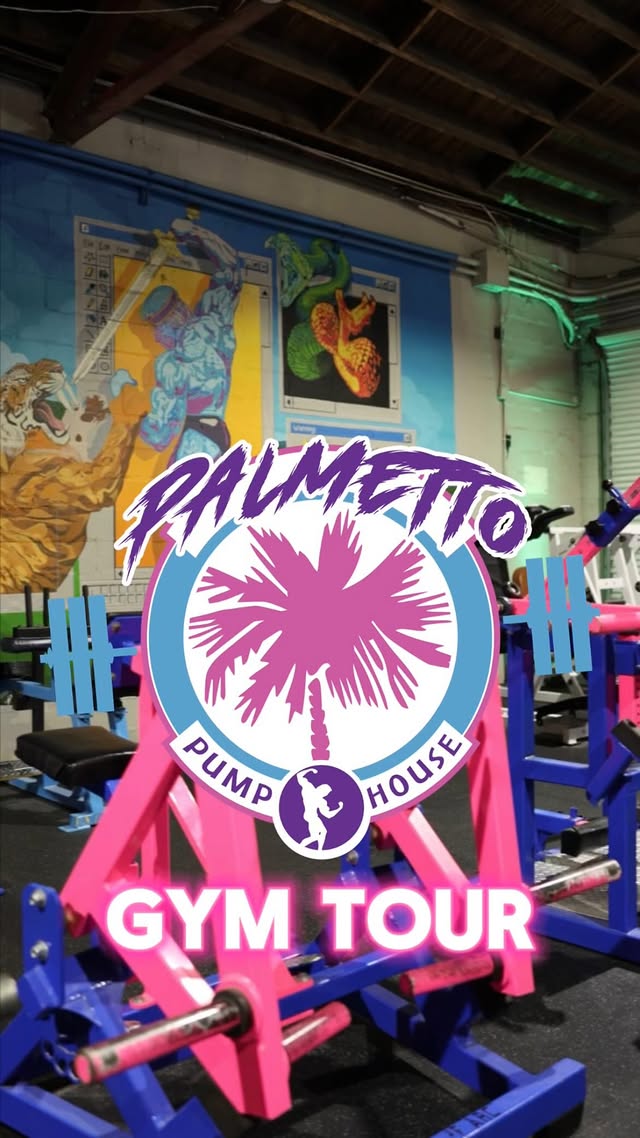
Strength training in Charleston, SC has exploded beyond the old-school bodybuilding and cardio binary. From North Charleston to Mount Pleasant, James Island to West Ashley, thousands of people are discovering that progressive resistance training is the single most impactful thing you can do for your health, longevity, and physical capability. This comprehensive guide covers everything from programming fundamentals to equipment requirements — and why a dedicated strength gym beats a chain fitness center every time.
At Palmetto Pump House on Rivers Ave in North Charleston, strength training isn’t a subcategory on a menu of classes. It’s the foundation of everything. Competition squat racks, calibrated plates, deadlift platforms, chalk bowls, and 24/7 access — the infrastructure exists because strength training demands specific tools, and 560+ members depend on having those tools available whenever they need them.
Why Strength Training Is the Foundation of All Fitness
This isn’t opinion — it’s what the research says. A 2022 meta-analysis published in the British Journal of Sports Medicine found that strength training reduces all-cause mortality risk by 15% and cardiovascular disease mortality by 17%. Studies from the Journal of Bone and Mineral Research demonstrate that resistance training is the most effective intervention for preventing age-related bone density loss.

The American College of Sports Medicine recommends strength training at least two days per week for all adults. Yet most gyms in Charleston are built around cardio machines and group fitness classes, with strength equipment treated as an afterthought.
The data is unambiguous:
- Muscle mass is the single strongest predictor of longevity after age 40, according to research published in the American Journal of Medicine.
- Resistance training increases insulin sensitivity by up to 25%, reducing Type 2 diabetes risk (Journal of Clinical Endocrinology & Metabolism).
- Strength training reduces symptoms of anxiety and depression with effects comparable to medication in some populations (JAMA Psychiatry, 2018).
- Progressive overload increases resting metabolic rate by 7-8% through lean muscle gain, making body composition management easier long-term.
- Bone mineral density improvements from resistance training can reverse osteopenia and reduce fracture risk by up to 40%.
If you live in Charleston and you’re not strength training, you’re leaving the most impactful form of exercise on the table.
Progressive Overload: The Only Principle That Matters
Every effective strength training program is built on one principle: progressive overload. You must systematically increase the demands on your muscles over time. Without progressive overload, you’re exercising — not training.
Progressive overload manifests in several ways:
Adding weight to the bar. The most obvious method. If you squatted 185 lbs last week, you squat 190 lbs this week. This works well for beginners (linear progression) and becomes more nuanced for intermediate and advanced lifters.
Increasing volume. More sets, more reps, or both. Going from 3×5 to 4×5 at the same weight is progressive overload. So is going from 3×5 to 3×8.
Increasing training density. Same work in less time, or more work in the same time. Shorter rest periods between sets with the same weight and reps represents a progressive challenge.
Improving technique. A squat at 225 lbs with better depth, better bar path, and less energy leakage than last month is a form of progress — even if the weight didn’t change.
The key: you need to track your training. Without records, you’re guessing. A simple notebook works. An app works. What doesn’t work is showing up and doing whatever you feel like — that’s recreation, not training.
PRO TIP
The fastest way to stall your progress is to program hop. Pick a program, follow it for 12-16 weeks, evaluate, and then adjust. Switching programs every 3 weeks because you saw something new on social media guarantees you’ll never progress beyond novice levels.
Strength Training Programs That Work
There are hundreds of programs available. Most of them work if you follow them consistently. Here are the best options organized by experience level, all executable with the equipment at a proper strength gym:

Beginner (0-12 months of consistent barbell training):
- Starting Strength — 3 days/week, linear progression. Squat every session, alternating bench/press and deadlift/power clean. Simple, effective, proven.
- GZCLP — 4 days/week. Adds structure through tiered exercises (T1 heavy compound, T2 moderate compound, T3 light isolation). More variety than Starting Strength while keeping the linear progression model.
- 5/3/1 for Beginners — Jim Wendler’s system adapted for novices. Slower progression but sustainable long-term. Good option if you prefer a less aggressive approach.
Intermediate (1-3 years):
- 5/3/1 (various templates) — Weekly undulating progression with calculated training maxes. The Beyond 5/3/1 templates (BBB, FSL, BBS) add volume without overcomplicating the framework.
- GZCL Method — The full version with periodized T1/T2/T3 structure. Highly customizable to individual strengths and weaknesses.
- Juggernaut Method — Combines wave loading with high-volume phases. Excellent for lifters who respond to volume accumulation.
Advanced (3+ years, approaching competitive levels):
- Block periodization — Hypertrophy, strength, and peaking blocks cycled across 12-20 week macrocycles. Requires careful programming and recovery management.
- Conjugate/Westside Method — Max effort and dynamic effort days with rotation of main movements. Complex but effective for lifters who’ve exhausted linear and simple periodization models.
- Custom coaching — At the advanced level, individualized programming based on competition goals, weaknesses, and recovery capacity becomes necessary.
All of these programs require a gym with competition squat racks, proper bars, calibrated plates, and bench stations. They require chalk for grip on heavy deadlifts. They require platforms for pulling movements. They require the freedom to train with intensity without being told to be quiet. Palmetto Pump House provides all of it. Check out our powerlifting gym guide for more on training infrastructure.
The Equipment You Need for Serious Strength Training
Strength training equipment isn’t complicated, but it needs to be right. Here’s what matters and why:
Squat rack with safety bars. This is non-negotiable. A proper squat rack lets you squat heavy with the confidence that safety bars will catch the weight if you fail. Smith machines are not squat racks — they lock you into a fixed bar path that doesn’t match natural movement mechanics.
Flat bench with adjustable racks. Competition-width benches with proper rack height adjustment. The bench should be firm (not padded like a mattress) and wide enough to retract your shoulder blades without sliding off.
Olympic barbell (20 kg/45 lb). A proper bar with knurling for grip, center knurling for back squats, and sleeve rotation for clean and overhead work. Cheap bars bend under heavy loads and lack consistent knurl depth.
Plates — calibrated or accurately marked. When your program says squat 225, you need to load 225 — not 218 or 231. Calibrated plates are accurate to within 10 grams. Commercial gym plates can vary by 5-10% per plate, which compounds across multiple plates.
Deadlift platform. A proper pulling surface protects the floor, provides grip for your feet, and sets the bar at the correct height. Deadlifting on carpet over concrete is how you damage floors and develop bad pulling habits.
Chalk. Magnesium carbonate. It costs $5 for a block that lasts months. It improves grip force by up to 15%. Any gym that bans it has prioritized aesthetics over function.

Ready to train with real equipment? Book a free tour at Palmetto Pump House and see the difference between a strength gym and a fitness center.
Why a Dedicated Strength Gym Beats a Chain Gym
Chain gyms optimize for volume — maximum members paying minimum dues with maximum attrition. Their business model literally depends on you not showing up. According to IHRSA industry data, the average commercial gym has a 50% annual member turnover rate. They budget for it. They need it.
A dedicated strength gym like PPH operates on a different model entirely. The gym succeeds when members show up, train consistently, and stay long-term. That’s why the equipment is competition-grade, the access is 24/7, and the culture supports hard training.
The practical differences:
| Factor | Chain Gym | Palmetto Pump House |
|---|---|---|
| Squat Rack Wait (Peak Hours) | 15-30 minutes | Rarely more than 5 min |
| Deadlift Policy | “Don’t drop the weights” | Dedicated platforms |
| Chalk | Banned | Bowls at every station |
| Plate Accuracy | +/- 5-10% | Calibrated (+/- 10g) |
| Atmosphere | Casual / intimidation-free zone | Focused, supportive intensity |
| Business Model | Profits from non-attendance | Retained by member results |
| Community | Anonymous | 560+ engaged members |
“The gym that profits when you don’t show up has zero incentive to help you succeed. Choose a gym whose business model is aligned with your goals.”
Strength Training for Different Goals
Not everyone who walks into a strength gym wants to compete in powerlifting. Here’s how strength training applies across different goals — all achievable at a facility like PPH.
General Health and Longevity: Two to three sessions per week focusing on the fundamental movement patterns — squat, hinge, press, pull, carry. Research from the Harvard School of Public Health shows this minimal dose provides the majority of health benefits. You don’t need to live in the gym. You need to be consistent.
Body Composition: Strength training builds lean muscle mass, which increases your resting metabolic rate. Combined with reasonable nutrition, this is the most sustainable approach to long-term body composition. Crash diets and excessive cardio lower your metabolic rate. Strength training raises it.
Athletic Performance: Every sport benefits from strength. Faster sprints, harder hits, higher jumps, more endurance — they all have a strength component. The research is clear: stronger athletes are better athletes, all else being equal.
Competitive Powerlifting: Squat, bench press, and deadlift in competition under a standardized ruleset. If you want to test your strength against others, powerlifting provides the structure. Our powerlifting guide covers the competitive side in detail.
Injury Rehabilitation and Prevention: Physical therapists increasingly prescribe strength training as primary intervention for joint pain, back pain, and post-surgical recovery. Stronger muscles, tendons, and connective tissue are more resilient to injury. The most injury-prone population? Sedentary adults who don’t strength train.
The Charleston Strength Training Scene in 2026
Charleston’s fitness landscape has evolved significantly. While the city is still heavy on boutique studios and beach-body culture, the strength training community has grown substantially:
USAPL (USA Powerlifting) participation in South Carolina has increased year over year, with meets in the Midlands, Upstate, and Lowcountry regions drawing competitive lifters from across the state. Charleston-area lifters regularly compete at state and regional levels.
The general public’s understanding of strength training has shifted too. The idea that lifting weights makes women “bulky” (it doesn’t — hormonal differences prevent it) or that older adults shouldn’t lift heavy (the opposite is true — they need it most) is fading as education improves.
Gyms like PPH exist because the demand exists. When enough people in a community want to train seriously, facilities built for serious training emerge. The 560+ membership count at PPH isn’t marketing inflation — it’s evidence of unmet demand in the Charleston strength training market.
Nutrition for Strength Training
You can’t out-train a terrible diet, but you also can’t optimize strength gains without adequate nutrition. The International Society of Sports Nutrition provides evidence-based guidelines that apply directly to strength training:
- Protein: 1.6-2.2 g/kg bodyweight daily (for a 180-lb person, that’s 130-180 grams per day). Space it across 3-5 meals for optimal muscle protein synthesis.
- Carbohydrates: 3-5 g/kg bodyweight for moderate training, 5-7 g/kg for high-volume training. Carbs fuel your workouts and support recovery. Don’t fear them.
- Fats: 0.5-1.5 g/kg bodyweight. Essential for hormone production (including testosterone, which drives strength adaptations in both men and women).
- Calories: To gain strength and muscle, you need to eat at or above maintenance. Chronic caloric deficits impair recovery, reduce training quality, and stall strength progress.
- Hydration: Even 2% dehydration reduces strength output by 10-15%. In Charleston’s heat and humidity, this is especially relevant. Drink before you’re thirsty.
PRO TIP
The supplement industry spends billions convincing you that pills and powders are the answer. The real answer is boring: protein from whole food sources, adequate sleep (7-9 hours), consistent training, and progressive overload. Supplements are, at best, the last 2% — not the foundation.
Recovery: The Missing Piece
Strength isn’t built in the gym. It’s built during recovery. Your training session creates the stimulus; your body adapts during rest. Ignoring recovery is like planting seeds and never watering them.
Sleep: Research from Stanford University demonstrates that sleep deprivation reduces strength output by 10-30% and impairs motor learning (your ability to improve technique). Seven to nine hours of quality sleep is not optional for serious strength training.
Deload weeks: Every 4-6 weeks, reduce training volume and/or intensity by 40-60% for one week. This allows accumulated fatigue to dissipate and sets you up for the next training block. Deloading isn’t weakness — it’s strategy.
Stress management: Cortisol (the stress hormone) directly impairs muscle protein synthesis and strength recovery. Chronic stress from work, relationships, or life circumstances doesn’t stay in one lane — it spills into your training. Acknowledge it. Address it. Your lifts will thank you.
Active recovery: Light movement on off days — walking, easy cycling, mobility work — promotes blood flow to recovering muscles without adding significant training stress. Charleston’s walking-friendly neighborhoods and waterfront paths make this easy to incorporate.
Getting Started at Palmetto Pump House
If you’re in the Charleston area and ready to take strength training seriously, here’s the path from zero to training at PPH:
- Try it first. Grab a $20 day pass or book a free tour. Walk the floor. Use the equipment. See if the environment fits.
- Pick a membership. Part-time ($80/mo), military/first responder ($90/mo), student ($95/mo), standard ($105-$115/mo), or couples ($155/mo). Full year option at $785. All month-to-month — no contracts.
- Sign up through Wellness Living and get your 24/7 key fob access.
- Pick a program. Beginner? Start with Starting Strength or GZCLP. Intermediate? 5/3/1 or the GZCL Method. Don’t overthink it — the best program is the one you’ll follow consistently.
- Show up. Three days a week minimum. Track your lifts. Add weight when the program says to. Trust the process.
The gym is at 4221 Rivers Ave, Suite 100, North Charleston, SC 29405. Call 843-608-1162 with questions. Check our guides on 24/7 gym access, no contract memberships, and finding the best gym in Charleston for more details.
The Long Game: Why Consistency Beats Intensity
Here’s the truth that no flashy fitness influencer wants to tell you: the person who trains consistently at 80% effort for five years will always out-lift the person who trains at 100% effort for three months before burning out.
Strength training is a decades-long endeavor. The strongest lifters in the world have been training for 10, 15, 20+ years. They didn’t get there through 90-day challenges or six-week transformations. They got there by showing up, session after session, year after year, adding small amounts of weight and accumulating thousands of hours of quality practice.
That mindset — patient, consistent, process-focused — is what separates a strength gym culture from a fitness center culture. At PPH, you’ll train next to people who’ve been lifting for decades and people who started last month. The culture supports both because the values are the same: show up, train hard, support each other, and play the long game.
Charleston has a lot of gyms. But if strength training is your priority — whether for health, performance, competition, or longevity — a dedicated strength facility with the right equipment, access, and community is the decision that compounds over years. That’s what Palmetto Pump House was built for.
READY TO GET PUMPED?
Join 560+ members at Charleston’s premier strength training gym. 24/7 access, competition equipment, zero judgment.
Frequently Asked Questions About Strength Training in Charleston
What is the best gym for strength training in Charleston?
Palmetto Pump House at 4221 Rivers Ave, North Charleston is the premier strength training facility in the Charleston area. Competition squat racks, calibrated plates, deadlift platforms, chalk, and 24/7 access make it the top choice for serious strength training.
How many days a week should I strength train?
Research supports a minimum of two days per week for health benefits. For strength and muscle gain, three to four days per week is optimal for most people. Advanced lifters may train four to six days. Quality and consistency matter more than frequency.
Is strength training safe for beginners?
Yes. Strength training has a lower injury rate than recreational running and many team sports. Starting with proper form, appropriate weights, and progressive loading makes it one of the safest forms of exercise. Training in a properly equipped facility with safety bars and experienced lifters around you further reduces risk.
How much does a gym membership cost at Palmetto Pump House?
Memberships range from $80/month for part-time to $115/month for standard full access. Military and first responders pay $90/month. Students pay $95/month. Couples can join for $155/month. Full year memberships are $785. All month-to-month with no contracts. Day passes are $20.
Do I need a personal trainer to start strength training?
Not necessarily. Programs like Starting Strength, GZCLP, and 5/3/1 for Beginners are well-documented and can be followed independently. However, even one or two sessions with a qualified coach can help establish proper form and prevent early bad habits. The community at PPH is also a resource — experienced lifters are typically happy to help with form checks.
Leave a Reply